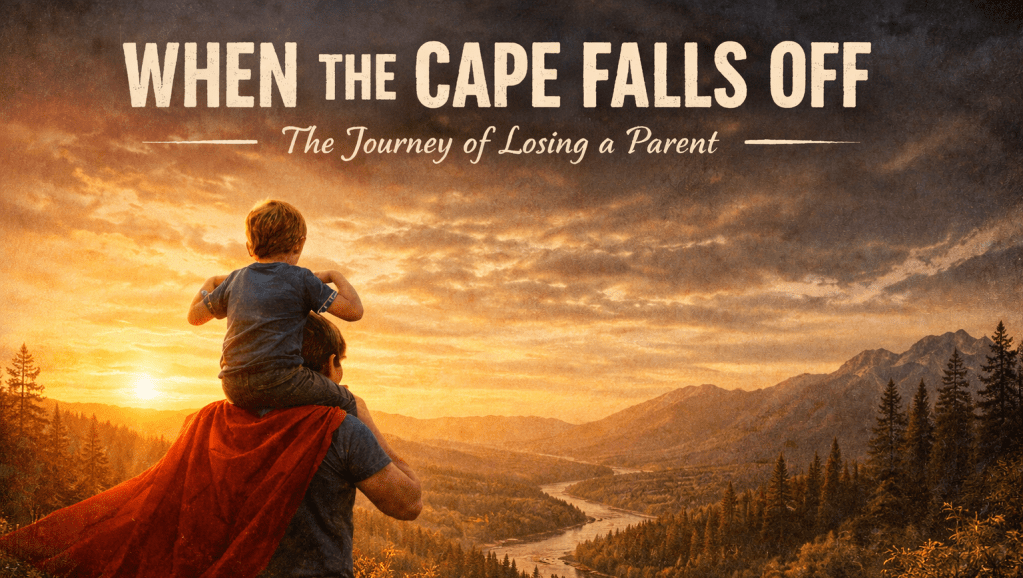
The Journey of Losing A Parent
Like most kids growing up in the early 90’s, my world was littered with superheroes. Saturday mornings were spent parked in front of the tv watching Captain Planet and The Power Rangers battle the forces of evil to restore order to the world. The fictional characters of my Saturday morning were certainly aspirational, but the superhero I admired most was usually sipping on his coffee in the family living room while I was ogling at the epic tales on display in the world of colourful cartoons. He was the one who hoisted me onto his shoulders as we paraded through the streets on a family outing; the one who held all the answers to the profoundly complex existential questions I had at the age of 7; and the one who inconspicuously swooped in with his hand on my seat to steady the wobbling tires of my two-wheeled bike that had just shed its training wheels. Dad’s cape wasn’t one that was boastfully on display, but I knew for certain that it was there. He was the hero I looked up to, admired, and wanted to be like.
Every great life story has a version of the hero’s journey built into it, and although the lights, cameras, and flashy movie sets weren’t always there to capture Dad’s great epic, he certainly had one. The hero’s journey starts with a call for adventure where the hero leaves their familiar world behind. They face challenges, learn a lesson or two, and return home changed and wiser – attaching new meaning to their old world. That storyline is woven into many of the chapters of Dad’s life – pivot points that established the principled values he chose to live by, and shaped the man who he would become. His accomplished career playing and coaching basketball was responsible for his ability to persevere, his belief in the importance of the collective, and his capacity for humble leadership. The summers he spent surveying with his uncle in northern Ontario instilled in him the value of hard work. His depth of love and the fundamental conviction he held in the power of family was a product of the joy-filled 50 year adventure he spent married to his high school sweetheart, and his lived experience as a son, brother, and wonderful father. His tenacity and deeply-rooted belief in fighting for the value of all people was in large part due to the expansion of his world courtesy of the introduction of a son born with a developmental disability. It’s an impressive connect-the-dots adventure that leads to a beautiful unravelling of the layers of a complex man who had kindness and compassion anchored to his core. But the final great epic and pivot point of Dad’s heroic story was his harrowing journey with Alzheimer’s.
They call it the long goodbye – a continuous deterioration of the mental cognition and physical capabilities of a person who once stood with their two feet so firmly on the ground. The uncertainty of timelines, body autonomy, and potential behaviour outcomes creates a vortex of confusion and an impossibility to plan for the future. It forces your loved ones to grieve your departing of the physical world in a trail of crumbs – a stacking of grief as the rolling waves of the disease relentlessly and repeatedly gather momentum and batter your shoreline. And there’s no blame to cast – just a neutral acceptance of what is, a scrambling to figure out how to balance it all, and the guilt attached to gauging what the best course of action is for care. For Dad, it began with an occasional forgetfulness mishap – lost keys or a missed item on the grocery list, and it morphed into a gradual desertion of presence and a constant evolution in the version of the man we loved. The trajectory of the disease feels endless, until you suddenly find yourself sitting at his bedside in the hospital room during the final days.
I’m fortunate that my proximity to death over the course of my lifetime has been distant. It was territory I hadn’t yet walked, and as much as I’d prefer that it maintained that distance, I’m aware and prepared that I likely won’t have much choice. Death delivers a palpable rawness. It’s a high voltage dose of reality, and the most honest expression of the fragility of the human condition. It’s an inevitable natural process that forces an eerie friendship with the recognition of how powerless you are in being able to change the trajectory of it. The quiet days and calm nights; the conversations with doctors; the nurse rounds to administer pain relief to ensure his comfort; watching the blanket wrapped around him rise and fall with the elevation and relaxation of his diaphragm; the comedic interventions to alleviate the tension and abrasiveness of the reality of the circumstance; searching his eyes for a glimmer of recognition or awareness as he falls in and out of lucidity; and confusion as to whether the decisions you’re making are the compassionate ones that are in his best interest, or if your desire to hold onto him in this world just a little longer is clouding your ability to make the coherent choice. It’s a profoundly sobering experience to be in a room with a loved one as they make their exit.
And as you’re witnessing the physical deterioration and natural process that the human body goes through when death approaches, you’re simultaneously hit with the uncontrollable emotional swells that show up without warning. The gut-wrenching belly heaves of sadness that envelope the body during long car rides back from the hospital – with the only response that offers any type of solace being the cascading tears that spill from the eyes and the deep sobs that emanate from the bellows of the insides. The montage of our shared life moments plays on the video screen that sits on the underside of my eyelids as I close them to catch some rest, and it’s here that all the happy memories bond to the deep sadness attached to his departure – a polarizing blending and a wholistic representation of the expansive life I was fortunate to be so intertwined with.
What a bizarre journey it is to watch somebody you’ve known your entire life to be so strong, independent, and empowered, completely transform and involuntarily welcome in such vulnerability, helplessness, and dependency on the people around him. To go from the beloved and invincible hero who provided so much to so many, to the man who had to utilize every ounce of energy just to draw in a single breath. But it was in these moments of extreme fragility – where every breath was a grasp to retain life; where he had nothing else to give; where he’d been fully stripped of his cape – that the magnitude of his impact in the world fell on me. It’s here that I recognized the true heroism.
I watched Dad closely over the years. There was a softness to him – a soothing and stable voice that held things steady when tension or conflict arose. He had a kindness he exhibited when he interacted with others, and a compassionate determination to advocate for the value of all people. There was integrity in the way he showed up in the world and led – with humility, a quiet confidence, and a willingness to listen. But there was a sternness to him too. He stood up to the bullies and cheered for the underdogs. He believed in the importance of rules and order. He didn’t tolerate disrespect and let you know when you were out of line. He also had a wildly expansive sense of humour – the mischievous kind that gently taunted and teased, with a knack for leaning into the subtle comedy that showed up when life teaches the lessons it so often does.
It’s a really beautiful thing when loss hits to analyze the architecture of a life that’s been well lived. Throughout this dissection of Dad’s journey, and the recognition of its effect on mine, I’ve come to realize that Dad’s cape wasn’t deteriorating and disappearing with the progression of his disease. Instead, he’d been strategically cutting out patches of that cape and weaving them into the fabric of the people he encountered as he moved through his life. He was deliberate in gifting the lessons that he knew were fundamental building blocks in the creation of a life lived with integrity, humility, and kindness, and he spent his years distributing those lessons on the basketball courts that his athletes played on; in the classrooms that his students learned in; in the home that his children were raised in; and in the spaces that community members gathered in.
The stories that resurfaced from former students, players, teammates, friends, and family at Dad’s celebration of life were a showcasing of those patches – a restoration of his cape on full display courtesy of his far-reaching impact on the people he touched – integrated into their character, their moral compass, and their belief systems; in their determination to persevere through difficult circumstances; in their confidence to stand tall and to challenge broken systems; and in their willingness to be kind. I find immense comfort in the idea that Dad lives on in the hearts and minds of so many. In a world where there’s such an emphasis on capitalist ambition, the individual, ego and status, Dad quietly and humbly built a legacy of compassion, kindness, and community. And it’s this quiet and subtle approach to life that I find so heroic.
The hero is the one who simply decides to participate – who wakes up in the morning with an understanding of the cosmic insignificance of his existence, yet chooses to engage in the betterment of the lived experience of the people he has access to. What an admirable, empowering, impactful, and achievable legacy. The legacy, I’d argue, of a true hero – one who now peacefully rests without his cape.


 SCOTT COULTHARD
Leave a reply to Wendy Bullock Cancel reply